Muscles / Hips
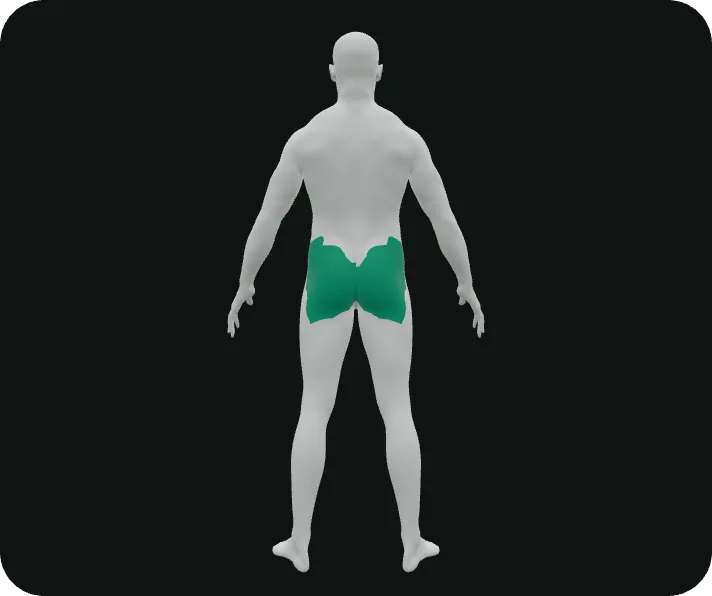
Piriformis
- Hips
- Hip & gluteal
- Deep layer
Anatomy
- Origin
- Anterior surface of the sacrum (S2-S4), margin of the greater sciatic notch, sacrotuberous ligament
- Insertion
- Superior border of the greater trochanter
- Nerve
- Nerve to piriformis (anterior rami of S1-S2) (S1-S2)
Actions
- Laterally rotates the extended hip
- Abducts the flexed hip
- Steadies the femoral head in the acetabulum
Exercises that train it most
Notes
- The sciatic nerve usually exits below it; anatomical variants may pierce it (proposed in "piriformis syndrome").
- Its rotation action reverses to medial rotation above about 60-90° of hip flexion, which is why stretches combine flexion, adduction and external rotation.
References (5)
- Gulledge BM, Marcellin-Little DJ, Levine D, et al. Med Eng Phys. 2014;36(2):212-218. Comparison of two stretching methods and optimization of stretching protocol for the piriformis muscle
- Neumann DA. Elsevier. Kinesiology of the Musculoskeletal System: Foundations for Rehabilitation. 3rd ed.
- Standring S, ed. Elsevier. Gray's Anatomy: The Anatomical Basis of Clinical Practice. 42nd ed.
- Dalley AF, Agur AMR. Wolters Kluwer. Moore's Clinically Oriented Anatomy. 9th ed.
- Betts JG, Young KA, Wise JA, et al. OpenStax (free, openly licensed textbook). Anatomy and Physiology 2e