Exercises / Forearm & wrist
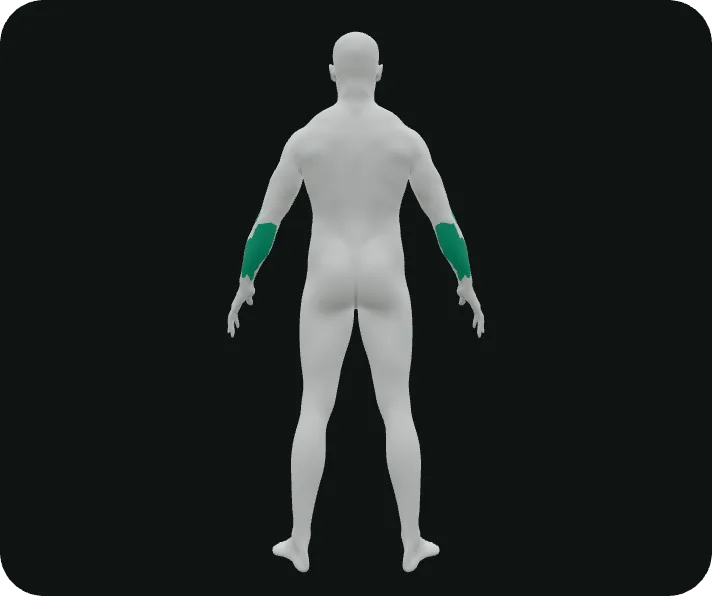
Radial and ulnar deviation with a hammer
- Strength
- Forearm & wrist
- Hammer or weighted bar
Tilting a hammer up and down at the wrist loads the muscles that move the wrist toward the thumb or little-finger side.
Also called hammer wrist tilt, wrist deviation strengthening.
Where you stand
No published distribution for this exercise yet. We add one only from a peer-reviewed study.
Muscles worked
- Extensor carpi radialis longus
- Flexor carpi radialis
- Extensor carpi ulnaris
- Flexor carpi ulnaris
- Abductor pollicis longus
Filled: primary. Outlined: secondary.
How much
Common clinical dose: 2-3 sets of 8-12 repetitions at a load that is hard by the last repetition, 2-3 days per week (ACSM novice guideline). Adjust to symptoms.
Start: Standing, arm by the side
Steps
- Stand with the arm straight by the side, holding a hammer near the handle end with the head forward.
- Tilt the head of the hammer up toward the ceiling by moving only the wrist (radial deviation), then lower slowly.
- Turn the hammer so the head points behind you and lift it backward the same way (ulnar deviation).
Cues
- Only the wrist moves
- Hold the handle farther from the head to make it easier
Common mistakes
- Bending the elbow
- Swinging the arm
Used for
- Wrist strengthening after fracture or sprain
- Grip-dominant work and sport
Evidence (1)
- Radial deviation pairs the radial wrist extensor and flexor; ulnar deviation pairs extensor and flexor carpi ulnaris.1
Easier
References (2)
- Neumann DA. Elsevier. Kinesiology of the Musculoskeletal System: Foundations for Rehabilitation. 3rd ed.
- Dalley AF, Agur AMR. Wolters Kluwer. Moore's Clinically Oriented Anatomy. 9th ed.