Exercises / Back & spine
Thoracic extension over a foam roller
- Mobility
- Back & spine
- Foam roller
Extending the upper back over a roller mobilises the thoracic spine and uses the thoracic erector spinae and deep transversospinal muscles.
Also called foam roller extension, upper back extension.
Where you stand
No published distribution for this exercise yet. We add one only from a peer-reviewed study.
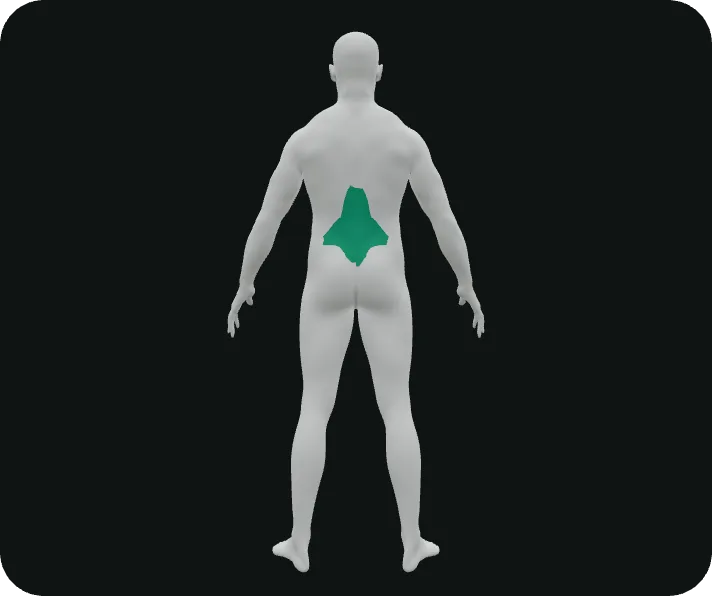
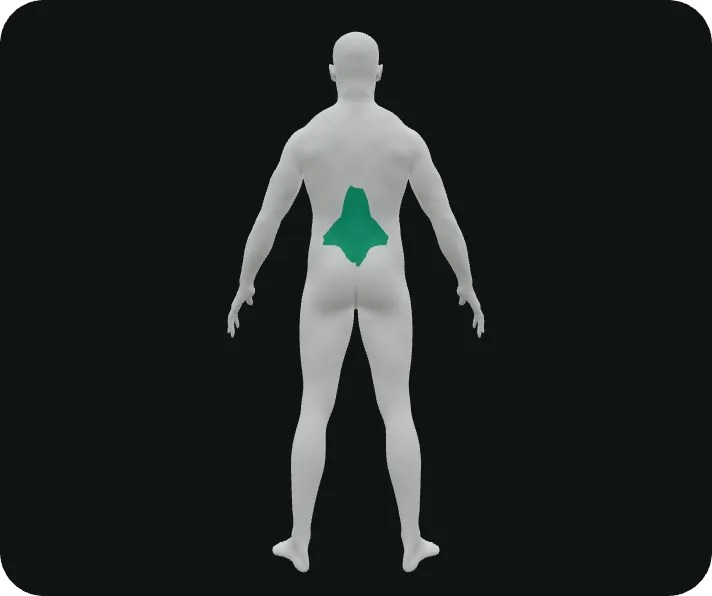
Muscles worked
- Erector spinae
- Semispinalis thoracis
- Rotatores
- Interspinales
- Levatores costarum
- Serratus posterior superior
- Serratus posterior inferior
Filled: primary. Outlined: secondary.
How much
Common clinical dose: 5-10 slow repetitions at 2-3 levels, once a day.
Start: Lying on the back, roller across the upper back
Steps
- Lie on the back with the knees bent and a foam roller across the upper back, below the shoulder blades.
- Support the head with the hands, elbows pointing up.
- Keeping the ribs down, extend the upper back over the roller, then return. Move the roller up a few centimetres and repeat.
Cues
- Bend around the roller, not at the neck or low back
- Breathe out as you extend
Common mistakes
- Arching the low back
- Pulling on the head
Used for
- Thoracic hyperkyphosis
- Upper back stiffness
- Shoulder pain with a stiff thoracic spine
Take care (1)
- Avoid with known or suspected osteoporotic vertebral fracture; use a gentler supported extension instead.
Evidence (1)
- Six months of physical therapist-led spine strengthening and posture training reduced kyphosis (Cobb angle) in older adults.1
Harder
References (4)
- Katzman WB, Vittinghoff E, Lin F, et al. Osteoporos Int. 2017;28(10):2831-2841. Targeted spine strengthening exercise and posture training program to reduce hyperkyphosis in older adults: results from the study of hyperkyphosis, exercise, and function (SHEAF) randomized controlled trial
- Neumann DA. Elsevier. Kinesiology of the Musculoskeletal System: Foundations for Rehabilitation. 3rd ed.
- Dalley AF, Agur AMR. Wolters Kluwer. Moore's Clinically Oriented Anatomy. 9th ed.
- Vilensky JA, Baltes M, Weikel L, Fortin JD, Fourie LJ. Clin Anat. 2001;14(4):237-241. Serratus posterior muscles: anatomy, clinical relevance, and function