Exercises / Back & spine
Lat pull-down
- Strength
- Back & spine
- Cable column with a bar (or a band anchored overhead)
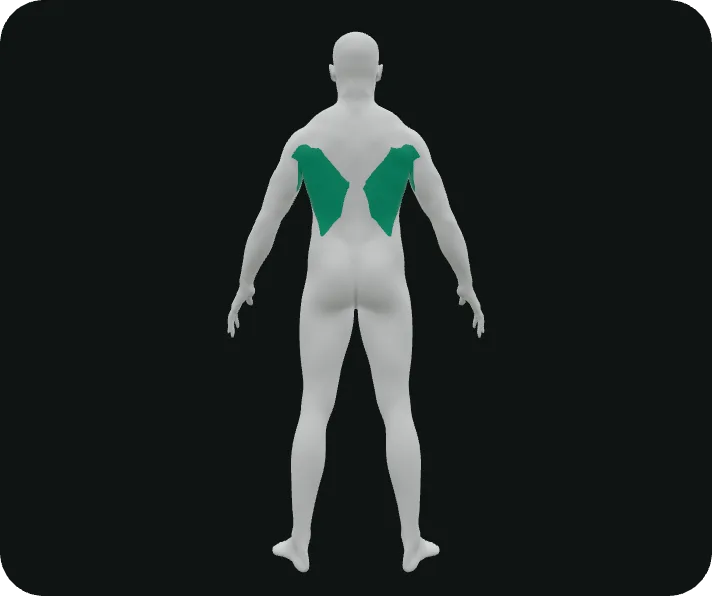
Pulling a bar from overhead to the upper chest works latissimus dorsi and teres major, with the lower trapezius and rhomboids controlling the scapula.
Also called cable pulldown, band pull-down, latissimus pull-down.
Where you stand
No published distribution for this exercise yet. We add one only from a peer-reviewed study.
Muscles worked
Filled: primary. Outlined: secondary.
How much
Common clinical dose: 2-3 sets of 8-12 repetitions at a load that is hard by the last repetition, 2-3 days per week (ACSM novice guideline). Adjust to symptoms.
Start: Sitting, arms overhead
Steps
- Sit facing the machine and hold the bar a little wider than shoulder width, arms straight overhead.
- Draw the shoulder blades down, then pull the bar to the top of the chest, elbows moving down and back.
- Let the bar rise slowly until the arms are straight again.
Cues
- Chest up, lean back only slightly
- Lead with the elbows
Common mistakes
- Pulling behind the neck
- Leaning far back and swinging
- Shrugging at the start
Used for
- Upper-body pulling strength
- Scapular depression control
Take care (1)
- Pull to the front of the chest; behind-the-neck pulling stresses the shoulder.
Evidence (1)
- The wide-grip pulldown and seated row gave the highest latissimus dorsi activation relative to biceps.1
References (3)
- Lehman GJ, Buchan DD, Lundy A, Myers N, Nalborczyk A. Dyn Med. 2004;3(1):4. Variations in muscle activation levels during traditional latissimus dorsi weight training exercises: an experimental study
- Dalley AF, Agur AMR. Wolters Kluwer. Moore's Clinically Oriented Anatomy. 9th ed.
- Neumann DA. Elsevier. Kinesiology of the Musculoskeletal System: Foundations for Rehabilitation. 3rd ed.